Punjabi Poems of Nasreen Anjum Bhatti: Talat Afroze

Nasreen Anjum Bhatti (1943–2016) was a Pakistani poetess who wrote poems in Urdu, Punjabi, Sindhi and English languages. She was also a painter and a broadcaster/producer at Radio Pakistan’s Lahore studios. Nasreen Anjum Bhatti’s Punjabi poems tell the story of the Pakistani Woman: both the rural Pakistani Woman and the urban Pakistani Woman. They are stories about sub-humanization of women and Pakistani women living in terror and fear for most of their lives.

Her Punjabi poetry championed the cause of Feminism and Human Rights. She was a progressive minded poetess who raised her voice against male dominance and patriarchy in Pakistan.

In her poetry, she creates surrealist images with a rich diction. Nasreen effortlessly knits poems with a sharp craft and facility to twist the ordinary words and phrases into stunningly beautiful lines. She challenges patriarchy, dictatorship and all other forms of oppression. Her works could be described as a bridge between folk songs, classical and modern Punjabi poetry.

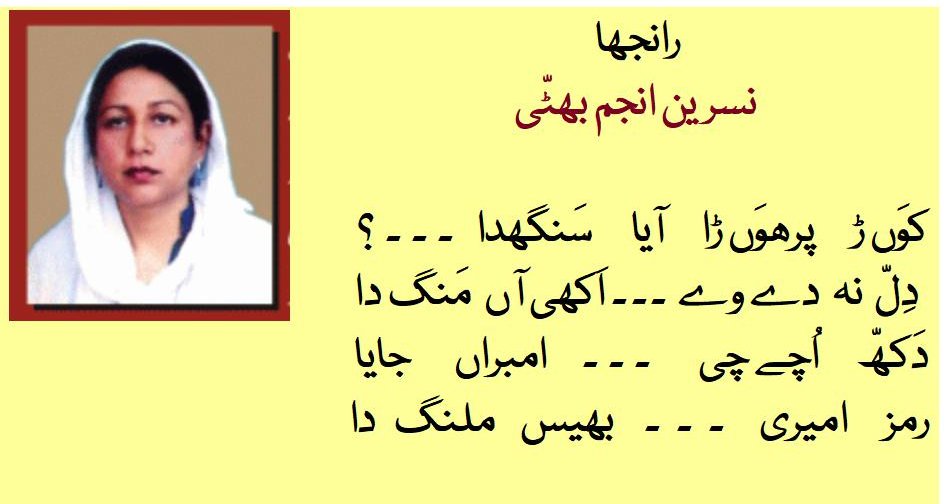
Mushtaq Soofi writes: “Nasreen Anjum Bhatti is the female voice, soft but strong, dominating our poetic landscape. This feminine voice debunks the image of the Pakistani Woman as she is perceived and on the other celebrates the potential of the Pakistani Woman . . . a source of Life and a protector of Life.

Nasreen Anjum Bhatti is ruthless in exposing not only the oppressively dominant male but also the slavishly subservient female who carries an internalized image of the female as sub-human as projected socially by the male.

One of her short unpublished poem says it all: ‘I have heard the pains conversing / I have heard, inside the man resides another man who doesn’t let him live/ these two men are born simultaneously as twin? Or the other man is born of the man later/ can you tell me? /my man has gone out somewhere/ when he comes back/ I will ask him and let you know’.

If we want to know the answer to the identity of the Pakistani woman, we will find it somewhere in Nasreen’s poetry where we find that Man comes up as a companion and exploiter, a confidante and a tormentor simultaneously.”

Apna Org complete text of Neel Karaiyaan Neelkaan by Nasreen Anjum Bhatti

Apna Org complete text of Atthay Pehar Taraah by Nasreen Anjum Bhatti

Rekhta Urdu poems of Nasreen Anjum Bhatti

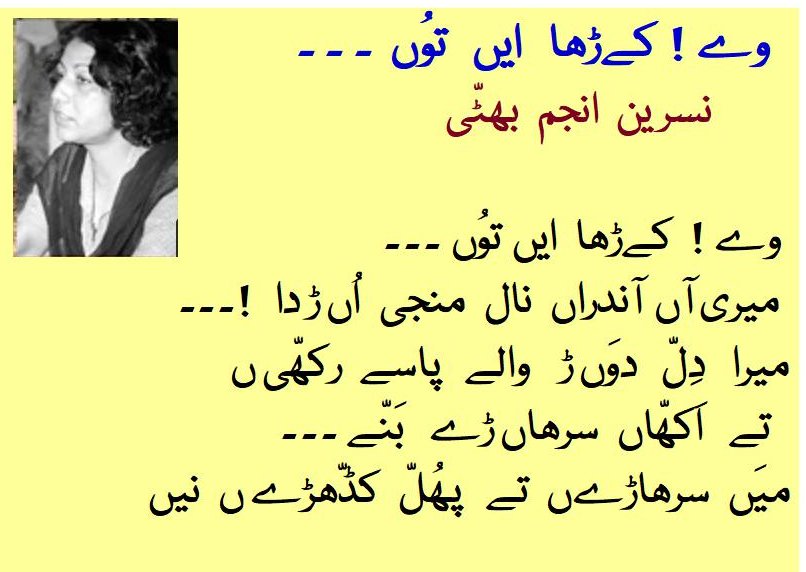
Vimeo video: Recitation of Nasreen Anjum Bhatti’s Punjabi poem Ve Kayrrha ain toon:

نیِل کرائیاں نیلکاں

اٹھّے پہر تراہ

شام لاٹ

بن باس

تیرا لہجہ بدلنے تک

Nasreen Bhatti was a progressive minded poetess who raised her voice against the brutal dictatorship of mardood General Ziaul Haq and protested the judicial murder of Zulfiqar Ali Bhutto which crushed the hopes of middle class and working class Pakistani people. Her poetry has been described as a bridge between folk songs, classical punjabi poetry and modern Punjabi poetry.

Nasreen Bhatti was born in Quetta, Balochistan province, Pakistan but spent her childhood in Jacobabad, Sindh province, Pakistan. She got her early education in a school in Quetta where the Hazara girls would speak Persian. She was raised as a Christian by her parents who provided an art friendly environment at home. She completed her B.A. degree from Lahore College for Women and did her Master’s in Urdu from the renowned Oriental College Lahore (Punjab University) in 1970 before joining Radio Pakistan in 1971 as a Producer. Later she completed her Masters in Punjabi during her employment.  During her employment, she also enrolled to study Painting and Fine Arts at Lahore’s prestigious National College of Arts (NCA) for two years but did not finish to get a diploma. Her husband Zubair Rana, Mrs. Naseem Akhtar Bukhari, Shaista Habeeb (wife of Punjabi poet Fakhar Zaman), Fakhar Zaman, Munir Niazi, Abdullah Hossein and Najam Hossain Syed were among her close friends.

In 1979, when Pakistan’s dictator mardood General Ziaul Haq arranged the judicial murder of Zulfiqar Ali Bhutto, Nasreen Bhatti published her first collection of Punjabi poems which included the long poem Bhutto Dee Vaar. She became an active member of Lahore city’s various literary societies like the Halqa Arba e Zauq literary meetings at the Pak Tea House, Lahore during the 1970s. Her Urdu poetry collections are Bun Baass and Tera Lehjaa Badalnay Tak (2016)while her Punjabi poetry collections are Neel Karaiyan Neelkaan (1979), Atthay Pehar Taraah (2010) and Shaam Laat (2019).

Nasreen Bhatti states in an October, 2014 interview with Dawn newspaper’s reporter Naeem Sadhu:

In the Lahore of the 1970s, the “generation of writers was very energetic and haunted by the pain and agony of the 1947 partition of British India into the Republics of India and Pakistan and the riots and loss of millions of lives during partition. Even though we (Nasreen Bhatti) were the back benchers at the jam packed literary sessions at Pak Tea House, Lahore, we were a proud part of this literary fraternity,” she says.

Nasreen Bhatti talks about the politically-charged environment of the 1970s and 1980s with a great enthusiasm, “the age of Sartre and Albert Camus.”

“Being a government employee, I could not participate openly in political activities but I used to go to distribute political activism focused posters and hand outs at night with fellow comrades.”

“The assassination of Zulfiqar Ali Bhutto in 1979 created a shock wave and it was the beginning of the literature of resistance in Pakistan,” she adds.

“I was never inclined to write traditional romantic lines glorifying the love life of an individual. My romance deals with the collective pain and pleasure of the common people and their class struggle. So I created an idiom of my own. It was striking and shocking for the conventional poets and critics,” she explains.

She was grateful to Najam Hossain Syed, who encouraged her to go for innovative experiments amid hostile criticism from literary pundits.  The pro-people and radical poets, especially Bulleh Shah, Shah Hussain and Lateef Bhittai, have been her permanent sources of inspiration and energy.

Her first collection of Punjabi poetry, ‘Neel Karaiyan Neelkan’, published in 1979, made a lasting impression on modern Punjabi poetry and became her hallmark. It was followed by another collection, ‘Athay Pehr Tarah’, in 2010.  Her works were widely acclaimed and honoured with prestigious literary awards. She was awarded Tamgha-i-Imtiaz in 2011.

In April, 1979, Nasreen Bhatti had collaborated with some other poets such as Munir Niazi and Ahmed Faraz in publishing a collection of poems titled Khushboo ki Shahadat following the hanging of former prime minister Zulfikar Ali Bhutto. She also read a paper on Punjabi language and culture at the National Punjabi Conference and Pakistani novelist Abdullah Hussein, the chief guest at the occasion, had been very impressed by her presentation.

Nasreen Bhatti was a feminist Punjabi poet and a human rights activist. Nasreen Bhatti is considered to be one of the last crusaders of the “literature of resistance” in Pakistan. She challenged the inherited patriarchy-driven socio-cultural norms and class-based politico-economic structure through her poetic expression. She was a socially conscious artist who exposed Pakistan’s political system that is based on exploitation of human rights. She explored the complex process of how patriarchy worked through a network of cultural values, societal norms and traditions to create a gender biased society and reduced women to a commodity. Her poetry depicts an organic link between patriarchal practices and political oppression.

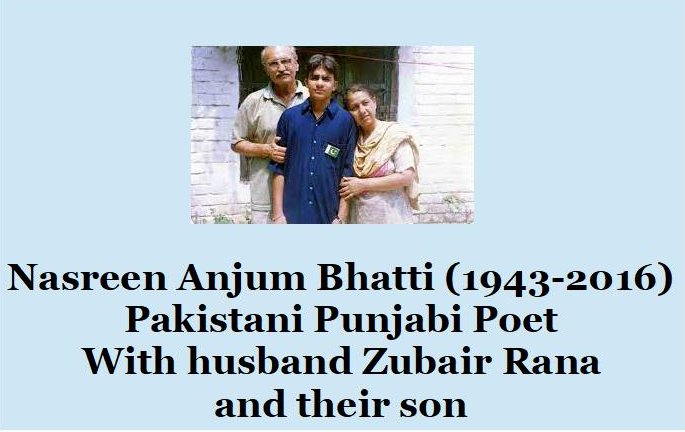
She worked in Radio Pakistan as producer, broadcaster and deputy controller. She also worked as resident director of Shakir Ali Museum, Lahore. She was awarded Tamgha-e-Imtiaz in 2011. Nasreen Bhatti was diagnosed with cancer in 2015 and put on chemotherapy at Central Military Hospital, Lahore. Later, she moved to Karachi where she was getting treatment at Pakistan Naval Services Hospital. She is survived by a son who has been abroad.
Vimeo video: Recitation of Nasreen Anjum Bhatti’s Punjabi poem Ve Kayrrha ain toon:

YouTube Video: A Conversation with Nasreen Anjum Bhatti

YouTube Video: Recitation of some Nasreen Anjum Bhatti Punjabi Poems

YouTube Video: Saba Pervaiz Kiyani talks about Nasreen Anjum Bhatti

Revive Punjabi, Support Urdu in Pakistani Punjab

پنجابی پھیلاؤ پر اُردوُ نوُں وی بچاؤ

Unfortunately, the start of the year 2021 has witnessed the launch of an extremist social campaign on social media about the future of the Punjabi language in Pakistani Punjab. A group of Pakistani Punjabi writers and scholars wants to revive Punjabi Language in Pakistani Punjab at the expense of kicking out Urdu from this province. These writers and scholars are advocating that Urdu is a foreign language in Pakistani Punjab and should be removed from this province’s government offices, schools, colleges and universities. Urdu should be banished from this province and in its place there should be a revival of the Punjabi language. They contend that Urdu should be kicked out of Pakistani Punjab and Punjabi should be taught as a Compulsary Subject in educational institutions of Pakistani Punjab. The assert that Punjabi language should be adopted as the official language in Pakistani Punjab’s government offices.

These writers and scholar contend that Urdu is not needed in Pakistani Punjab as a means of communicating with non-Punjabi Pakistanis. They are stating that Urdu no longer needs to be taught in the schools, colleges and universities of Pakistani Punjab nor should Urdu be allowed to remain the official language in Punjab Provincial Government offices, courts, provincial assembly et cetera. Instead, they argue that Punjabi should be made a mandatory subject in schools and at the intermediate level in colleges throughout Pakistani Punjab at the expense of Urdu. They believe that Urdu is not needed as “raabtay kee zubaan.” In other words, Urdu is not needed as a means of communication with between the Punjabi people and Sindhi, Balochi, Pushtoon, Kashmiri, Gilgati and Balti people residing in the various other provinces of the Pakistani Republic.
I feel that this is an extremist view and that BOTH Urdu and Punjabi should be taught in schools, colleges and universities of Pakistani Punjab. There could be many solutions possible. One option would be to make the teaching of Punjabi an Optional subject at the school and college level while keeping Urdu a Comnpulsory subject in schools and colleges. Another solution could be to make BOTH Punjabi and Urdu a Compulsory subject in schools and at the intermediate level in colleges.

I am all for an open, transparent debate on Facebook, Twitter, YouTube et cetera on this topic and I urge Pakistani Punjabis to remain polite in these social media debates and refrain from hate speech. This is the minimum that one can ask from a society nowadays.

His first assertion is that everything was fine with Punjabi language in the Punjab of the 18th Century. With the advent of British Colonialism in the 19th Century, Urdu was imposed as a foreign language on the people of the Punjab. This led to a systematic suppression of the Punjabi language throughout Punjab. The Urdu speaking Elite class and the Punjabi speaking Elite class colluded with the British colonialists to repress the Punjabi language and promote this foreign language Urdu in schools and colleges and universities throughout the Punjab. Mushtaq Soofi goes on to state that now the time has come for the citizens of Pakistani Punjab to take back ownership of the Punjabi language. Since Urdu was imposed on the Punjabis, therefore he argues that Urdu should no longer be allowed to be the official language of Pakistani Punjab. Urdu should not be taught in educational institutions of Pakistani Punjab. Instead, in place of Urdu, the Punjabi language should be taught everywhere in Punjab and Punjabi should become the official language in Pakistani Punjab’s government offices.

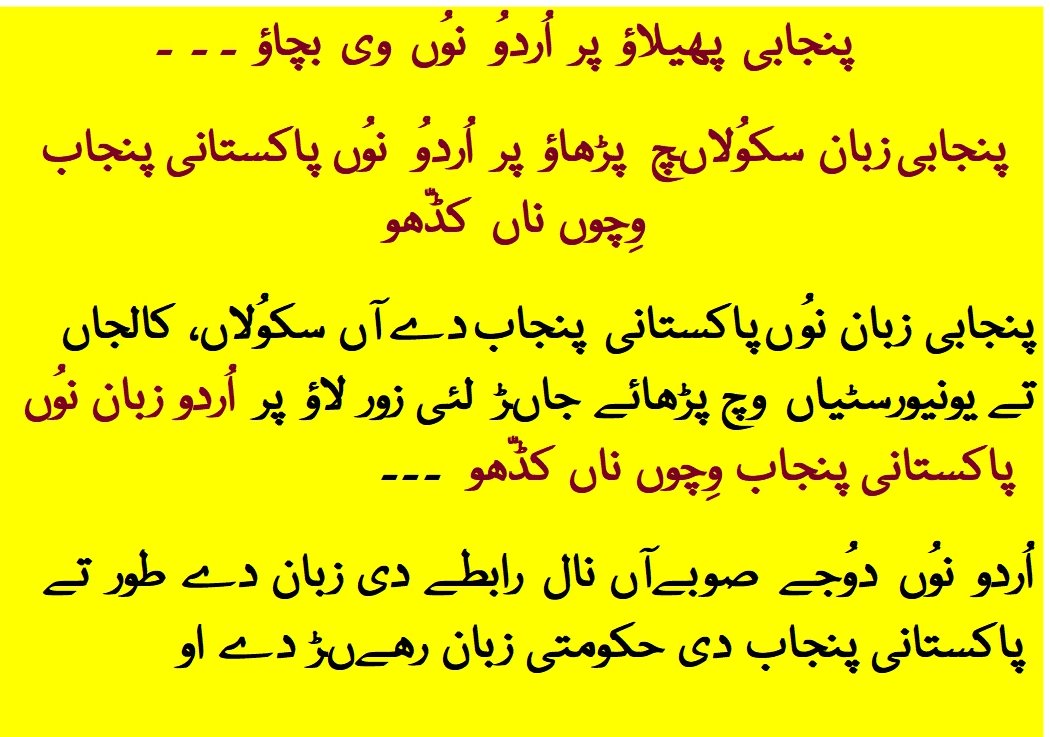
Mushtaq Soofi saheb is not alone in his views: Mr. Maqsood Saqib has also championed this view and he uploads facebook uploads daily to promote the viewpoint that Urdu should be kicked out of educational and government offices right away and Punjabi should be taught as the only regional language in all Pakistani Punjab schools, colleges, universities. No he says, no more Urdu as provincial “raabtay kee zubaan.” See the image of one of his recent facebook posts below.

Before I offer my critique of this extreme view expressed by Mushtaq Soofi saheb, I would like to present my interpretation briefly and to show the actual wording from Soofi saheb’s article in the Dawn. It is possible that I am interpreting his words incorrectly. I want my readers to judge for themselves:

Talat’s Interpretation of Mushtaq Soofi article in Dawn:

British Imposed Foreign Language Urdu on Punjabis; Adopt Punjabi and Banish Urdu in Pakistani Punjab.

Mushtaq Soofi’s actual words from article in Dawn, 18th January, 2021

(With the arrival of the British in India) a new education system was introduced the crucial component of which was the imposition (on the Punjabi people) of two foreign languages: English and Urdu were imposed as medium of instruction. English was meant for upper classes and Urdu for the lower orders. This proved to be turning point in the literary and cultural history of the Punjab as it started the process of alienating people especially younger generations from their mother language and cultural roots.

Urdu speakers who migrated from India and Punjabi elite were squarely responsible for de-culturation of historically rich people of Punjab in the name of acculturation.

Now the question is how to enculturate people at large, how to bridge the cultural divide? But still we can take the first step. We can make effort to retrieve the situation by owning what legitimately belongs to us; our language.

Let us accept that in the 19th Century, Urdu was a foreign language imposed on the Punjabi people and teaching Urdu in educational institutions but not teaching Punjabi led to suppression of Punjabi. I would like to point out, imploring my readers to keep a cool head and show Bardaasht/Tolerance, that there were some benefits as well when the British Colonials assumed power in the Punjab. At least with the advent of the British, we got the Printing Press and Classical Punjabi Poetry started being published in book form all over the Punjab as noted by the eminent Punjabi Scholar Syed Nazir Ahmad, the former Principal of Government College, Lahore who compiled Kalam e Bullay Shah and Kalam e Shah Hussain with funds from Syed Babar Ali (of Packages and LUMS fame) . . .

However, it is now the year 2021 . . . the British left about three-quarters of a century ago . . . We now live in a Pakistani Republic where Pakistani Punjab is one of many provinces. How can present day Pakistani Punjabis hope to communicate with the people of Sindh, Balochistan, Khyber Pakhtun Khawa, Gilgit Baltistan and Azad Kashmir? The easiest way would be to continue to nurture Urdu in all provinces of Pakistan. About 160 years have gone by (British rule officially started in 1858 and ended in 1947) since Urdu’s imposition on Punjabis. It is time to move on . . . It is my opinion that Urdu is no longer a foreign language to Punjabis. Many prominent Punjabi writers have created literature in BOTH Punjabi and Urdu. For example consider Munir Niazi, a man of letters who was Pathan by ethnic descent and created avant-garde poetry in both Punjabi (Honee day Heelay) and Urdu. Majeed Amjad wrote in Urdu but also composed one poem in Punjabi (Airport tay; which was about his longing to join his second love, the German tourist Charlotte). Ashfaq Ahmad wrote short stories in Urdu but also wrote Punjabi poetry (Annee mayree tain naa hondee, jay mayray vich main naa hondee, Daadee day kole rhen-daa, ta-tee roti khaandaa, chulhay day kole bhen-daa). The famous poet Ahmad Rahi wrote poetry in Punjabi as well as Urdu ghazals. Similarly, Tanvir Naqvi wrote memorable Urdu songs (Aawaz day kahaan hai) as well as blockbuster hit Punjabi songs (Jadon haulee jaee lay-naa mera naan).

I believe the middle way would be to continue to nurture Urdu but also to make vigorous efforts to revive Punjabi by beginning to teach Punjabi as an optional subject in all private schools and colleges and convince the Pakistani Punjab government to begin teaching Punjabi in government schools and government colleges/universities. Urdu should be allowed to remain one of the two official languages of Pakistani Punjab and as a language of communication with other Pakistani provinces.

Mushtaq Soofi’s second assertion in his Dawn article is that the modern Punjabi writer living in urban Pakistani Punjab feels lonely (the word loneliness appears in the title of his article), isolated and cut off from urban Punjabi readers. Soofi saheb asserts that this loneliness is there because urban Punjabis do not know real Punjabi language and so cannot appreciate and understand the fiction and poetry being created nowadays by urban Punjabi writers. Before I say something about this assertion, I again would like to present to my readers, my brief interpretation of these views side by side with the actual words used by Soofi saheb in his article:

Talat’s Interpretation of Mushtaq Soofi article in Dawn:

Modern Urban Punjab Writer is lonely and isolated because Urban Punjabi readers do not know real Punjabi language.

Mushtaq Soofi’s actual words from article in Dawn, 18th January, 2021

Now in the culture’s barren wilderness created by inertial forces when rupture with the indigenous tradition is complete, modern poet writing in people’s language faces a real dilemma.

He is not understood by people in the cities because they are totally cut off from their mother language.

They are the ones who can appreciate the modern poetic structures but they fail to do so because they don’t know the language and its literary conventions.

I always thought that Poetry was soliloquy overheard and that expressing oneself via Poetry was its own reward. Same thing with fiction. Poets and writers are hit with the creative urge (in Urdu it is termed Aamad) and away they go, carried on the waves of their imagination and this creative urge . . . So, in my opinion the Punjabi writer feeling lonely is at best a minor issue in his/her creative life. That is like all Pakistani poets and writers of fiction feeling sad that no one reads any literary books anymore, that there are no book clubs, no neighborhood public libraries and that no one buys books any longer in Pakistan. When the urban Punjabi poet/writer gets the creative urge, he/she could care less about whether the urban Punjabi reader would be able to understand his modern Punjabi creation. That is how Literature works: you write and forget about your readers and what they would think and whether they would be able to “get it.”

In the final analysis, the present day modern, urban Punjabi writer’s main concern is not that he/she is cut off from urban Punjabi readers because these readers don’t know “real” Punjabi whatever that term means. Punjabi is Punjabi . . . yes, Punjabi maybe a bit different if you live in a village or small town from what is spoken in the big cities of Pakistani Punjab. However, in my opinion, believing that not many urban Punjabi readers can appreciate a well written modern Punjabi poem or modern Punjabi short story appears to be an extremist view. So, to start a whole social media campaign on this one point that urban Punjabi readers don’t know “real” Punjabi and the urban Punjabi writer is feeling loneliness because of this is ludicrous, laughable and a bit of daydreaming on the part of the otherwise learned Mushtaq Soofi saheb. I ask my readers: Do you really believe that the millions of people living in Lahore, Faisalabad, Multan, Gujranwala, Sialkot et cetera do not know “real” Punjabi and cannot understand and appreciate a modern urban Punjabi poem, song, short story or play?

Mushtaq Soofi saheb’s final assertion in his Dawn article is that rural Punjabis living in villages and small towns all over Pakistani Punjab do not know modern city life and cannot understand the poetic structures employed in modern Punjabi writing. Before commenting on this, I would again like to show my brief interpretation of this view of Soofi saheb side by side with Soofi jee’s own exact words:

Talat’s Interpretation of Mushtaq Soofi article in Dawn:

Rural Punjabis don’t understand modern city life, complex poetic expressions and modern poetic structures

Mushtaq Soofi’s actual words from article in Dawn, 18th January, 2021

And those who know the language, mostly in country side and towns are unable to make sense of complex expression which is in their language but beyond their comprehension due to lack of exposure to modern life.

I want to say in response that Mushtaq Soofi saheb is implying that all rural Punjabi citizens stay put in their villages and small towns like a Curfew or Section 144 (prohibiting gathering of 5 or more citizens outside their homes) has been in force from 1947 to 2021 in rural Punjab . . . small towns all over Pakistani Punjab have Book Shops and books, magazine, newspapers arrive in these small towns. The internet and cheap mobile phones have enabled villagers and small town inhabitants to know about modern city life through YouTube, Twitter, Facebook, Instagram, Tik Tok and numerous web sites. Moreover, rural Pakistani Punjabis have been emigrating to various countries worldwide since the 1940s and 1950s. They have come back to their rural relatives and told them about the modern city experience. Also, do not forget that many urban Punjabis still have blood relations living in rural Punjab whom they talk to on the phone and whom they visit many times throughout the year. The world became a global village a long time ago Soofi saheb. Rest assured that rural Punjabis know a lot about modern city life.

Also, there is the phenomenon of many modern Punjabi poets having been born in villages and small towns: Munir Niazi in the small town of Khanpur, Shiv Kumar Batalvi in village Bara Pind Lohtian, Paash (Avtar Singh Sandhu) in village Talwandi Salem, Ahmad Rahi in Amritsar and Hazeen Qadri in village Raja Tamoli who went on to create modern Punjabi poetry which was accessible to, understood/appreciated by BOTH rural and urban Punjabi readers . . . To me, this proves that rural Punjabi readers can appreciate modern urban Punjabi writings.

About Dr. Talat Afroze, PhD (University of Alabama at Birmingham, USA, Molecular Biology, 1992) who is the author of this Blog post:
https://wordpress.com/me

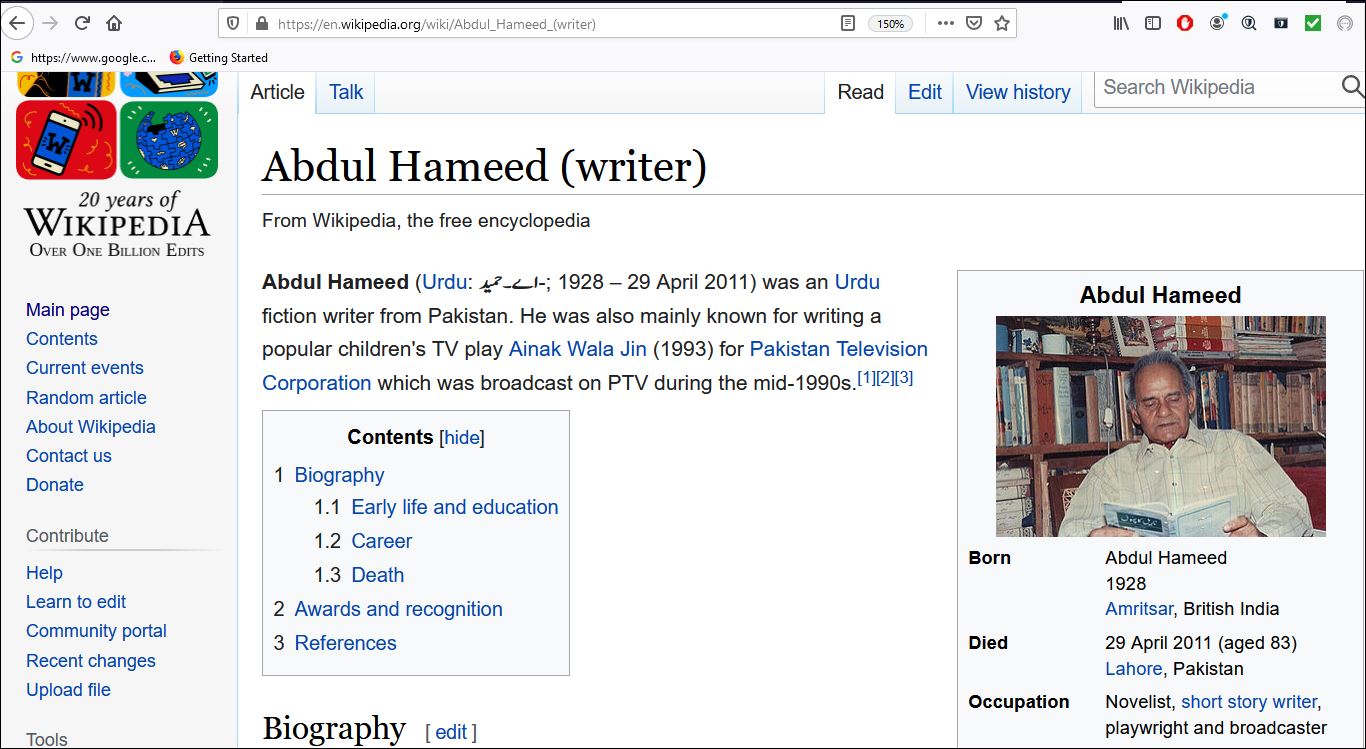
Writer A. Hameed (ڈربے ناول، منزل منزل افسانے، بارش میں جُدائی، نوائے وقت کالم امرتسر کی یادیں، بچوں کا ادب عینک والا جن پی ٹی وی ڈرامہ سیریز) was my Maamoon jaan.
Modern Poet Ahmed Mushtaq (close friend of Nasir Kazmi) is my relative, being the elder brother of my Phoophaa jaan Ahmed Ashfaq.


Problems in Typing Punjabi with Urdu Font

اُردوُ رسم الخط (فونٹ) نال

پنجابی ٹائپ کرں ڑ وِچ اڑچناں

طلعت افروز

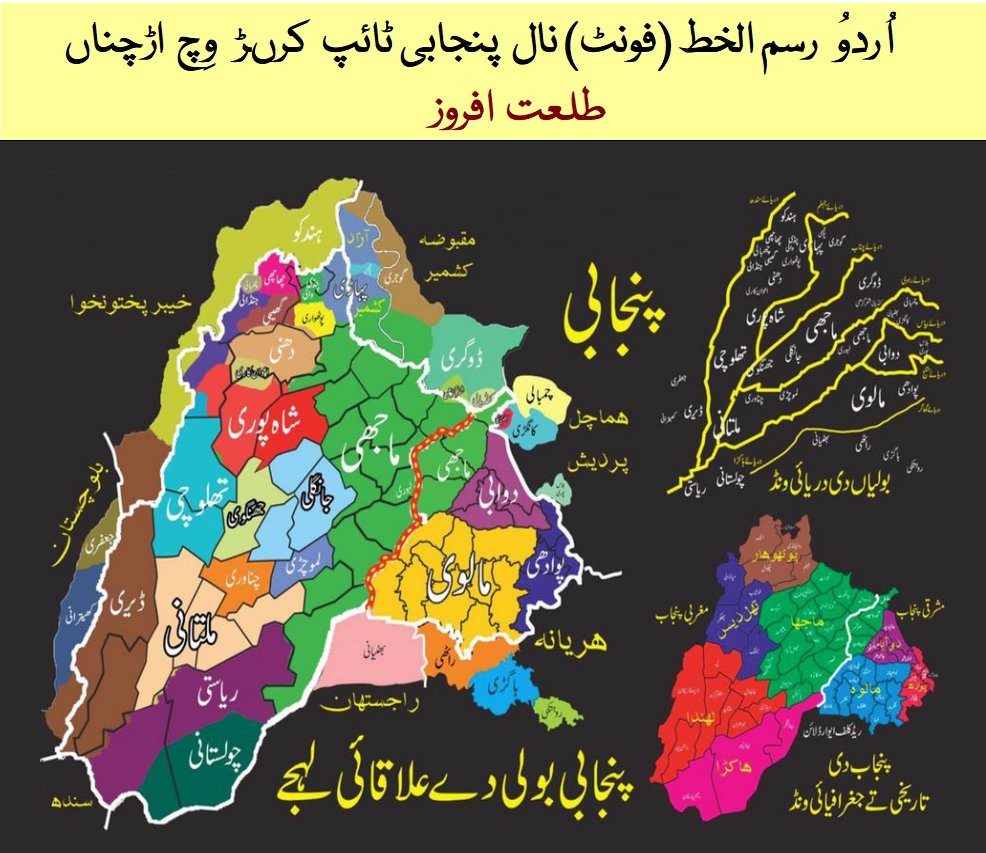
پنجابی زبان دے کئی لھَے جے (لہجے) نیں تے ایسے واسطے پنجابی شبداں دا تلفّظ وی علاقے دے نال نال بدلدا اے۔ اِنٹرنیٹ توں نقل کیِتے تے اُپر وخائے گئے ایس نقشے وِچ پنجابی دے مختلف لھےجےآں دا جغرافیہ وخایا گیا اے ۔ ہر لِخاری پنجابی ٹائپ کردے ہوئے اپںڑے علاقے دی وَسّوں تے لھَےجے دے مطابق پنجابی ٹائپ کرے گا۔ لھَور دی ’’پیکیجز کمپنی‘‘ آلے سیّد بابر علی دے سرمائے نال تے پنجابی زبان دے اعلٰی محقق ڈاکٹر نذیر احمد (پرنسپل، گورنمنٹ کولج، لھَور) دی تحقیق نال سنہ 1979 وِچ چھپی ’’کلام ِ شاہ حسین‘‘ دے دِباچے وِچ صفحہ ’’ع‘‘ تے ڈاکٹر نذیر احمد لِخدے نیں کہ لھَور وِچ سولھویِں صدی وِچ پنجابی لھَےجا ’’ ملتانی ‘‘ سی ایس واسطے شاہ حسینؔ دی کافی آں دا متن ایسے مُلتانی لھَےجے وِچ طبع ہویا مِلدا اے۔ ایسے طراں ’’پاکستان ٹائمز‘‘ اخبار دے مشہور ِ زمانہ کارٹونسٹ (’’ننّھا‘‘ کارٹون کردار دے خالق) تے پنجابی دے اعلٰی کہانی کار انور علی دی پنجابی کہاںڑیاں دی پَےلھی کتاب ’’کالی آں اِٹّاں کالے روڑ‘‘ دے پنجابی متن وِچ جلندھر تے لھَور دے لھےجیاں دا مِلاپ دِسدا اے ۔ فخر زمان دی شاعری تے ناولاں وِچ گجرات دا پنجابی لھَےجا مِلدا اے تے جدوں اشفاق احمد دے کردار ’’تلقین شاہ‘‘ نوُں سُ ںڑو تے جلندھر ، لُدھیا ںڑے دا لھَےجا صاف سُ ںڑےآ جا سکدا اے۔ جدوں فرحت عباس شاہ کےَنھدے نیں

بھانویں سَوکھا تے بھانویں تنگ جا ساں

انگلینڈ وں نھسّ کے جھنگ جا ساں

تے اوہ جھنگ دے لھَےجے وِچ بول رئے ہوندے نیں۔ مَیں چونکہ لھَور دی جم پل آں تے ایس واسطے میری پنجابی نظماں وِچ لھَور دا لھَےجا مِلے گا پر کِتے کِتے کوئی سرائیکی لفظ پسند آ گیا اے یا فیر شِو کمار بٹالوی دی پنجابی نظماں غزلاں توں کوئی مشرقی پنجاب دا رنگ ڈھنگ پسند آ گیا اے تے مَیں اوہنوُ ں وی شامل کر لیا اے۔

پاکستانی پنجاب دے لکھاریاں نوُں اپڑیِں رچنا کمپیوٹر دے کی بورڈ دے ذریعےٹائپ کرںڑ وِچ بوہت ساریِاں اڑچناں نیں۔ ایہدی مُڈّھلی وجہ اوہ اُردو رسم الخط اے جیدھے سہارے پنجابی نوُں “ شاہ مُکھی” طریقے نال ٹائپ کیتا جاندا اے۔ بھارتی پنجاب دے لکھاری نصیباں آلے نیں کہ اونھاں کول پنجابی لخںڑ تےٹائپ کرںڑ لئی گُر مُکھی رسم الخط موجود اے جیہڑا سولھویں صدی عیسوی وچ گُروُ انگڑ دیو جی نے تخلیق کیتا ۔ ۔ ۔ ایہہ رسم الخط اُچےچا پنجابی لخںڑ لئی بںڑایا گیا سی تے اجّ تیک اپںڑا مقصد پورا کر رھےآ اے۔ جد تیک پاکستانی پنجاب دے لکھاری، پاکستانی پنجاب دے کاڈھوُ (محقق) تے پنجابی نوُں ودھاوا دےںڑ آلے ادارے تے اونھاں دے ڈائریکٹر تے کرتا دھرتا حرکت وِچ نئیں آںڑ گے تے حکمت نئیں ازماںڑ گے اسیِں سارے لکھاری ایسے طراں پنجابی ٹائپنگ دی مُشکلاں وِچ گھِرے رھاں گے۔ اِکی ویں صدی دے پاکستانی پنجابی لکھاری دی مُڈّھلی منگ اے ایہہ کہ اِک اُچےچا پنجابی کمپیوٹر فونٹ تخلیق کیتا جاوے جِنھوُں اسیِں سارے اِنٹرنیٹ توں اپںڑے کمپیوٹراں وچ ڈاؤن لوڈ کر سکی اے تے فیر مائیکرو سوفٹ ورڈ یا فیر مفت سوفٹ وئیر اپاچی اوپن آفس نوُں استعمال کر کے پنجابی متن ٹائپ کر سکی اے۔ جےڑھے بزرگ اورئینٹل کالج، لھور تے پنجاب دی یونیورسٹیاں دے پنجابی ڈیپارٹمنٹاں دے سرپنچ نیں اونھاں نوُں انفارمیشن ٹیکنالوجی ( آئی ٹی) دے ماہراں نال مِل کے ایہہ کمّ کرنا چئ دا اے۔ اِک ماڑا موٹا پاکستانی پنجابی ادبی بورڈ وی لھور وِچ پایا جاندا اے تے میَں ستمبر سنہ 2020 وچ ایس بورڈ نوُں ای میل وی کیتی سی پنجابی کمپیوٹر فونٹ بناؤںڑ واسطے پر اونھاں کوئی جواب نئیں دِتّا۔ آؤ ہُں ڑ ذرا پنجابی ٹائپ کرںڑ آلی آں اڑچناں بارے کجھ گلاّں ہو جاںڑ ۔

پَےلھی گل تے ایہہ کہ پنجابی وِچ نوُن غُنّہ دی واز بَوھت سارے شبداں وِچ ’’ں ڑ ‘‘ ہوندی اے پر ایہدے لئی کوئی اُچے چا حرف ہتّھیں کتابت کرں ڑ واسطے تے کمپیوٹر وچ ٹائپ کرں ڑ واسطے تخلیق نئیں کیتا گیا ۔ کوئی پنجابی پبلشر ’’ں‘‘ دے اُتّے کاتب دے ذریعے گول دَےرہ بں ڑا کے ( اقبال قیصر ہوراں دی چھاپی کُلیات ِ شِو کُمار بٹالوی دا پنجابی متن ) تے کوئی ’’ں‘‘ اُتّے کاتب دے ذریعے ’’ط ‘‘ لِخ کے ’’ں ڑ‘‘ دی واز ظاہر کردے نیں۔ باقی بَوھت سارے پنجابی پبلشر ’’ں‘‘ دی جغا ’’ن‘‘ لِخ کے قصّہ گول کر دیندے نیں۔ جے انفارمیشن ٹیکنالوجی دے ماہراں دی مدد نال نواں تخلیق کیتا کوئی شاہ مُکھی پنجابی کمپیوٹر فونٹ تیار کر لےآ جاوے جےڑھا ’’ں‘‘ اُتّے چھوٹی جئی ’’ط ‘‘ ٹائپ کر سکے یا ’’ں‘‘ دے اُتّے چھوٹا جیہا گول دَےرہ ٹائپ کر سکّے تے ایہہ مُشکل دوُ ر ہو سکدی اے ۔

دُوجی گلّ اَکھّر “ح” ، اَکھّر “ہ” تے اَکھّر “ دو چشمی ھ “ دے بارے کرنی اے ۔ ایہہ ذرا دھیاں ڑ دےں ڑ آلی گلّ اے کیونکہ دو چشمی ھ ’’ح‘‘ کولوں (جِدی ٹھے ٹھ عربی والی واز وِچ ’’خ‘‘ دی جھلک ہوندی اے) تے ’’ہ ‘‘ توں وَکھ اَے ۔ دو چشمی ھ توں پَےلھاں آوں ڑ والے اکّھر دی واز ھ دے نال مِل جاندی اے تے اِک نویِں مُرکّب واز بں ڑ جاندی اے۔ بَوھت سارے پنجابی شبداں نوُں ٹائپ کردےآں ویلے پِشلے اکّھر نال ھ دا اکّھر ٹائپ کرناں پَےں دا اے تاکہ پنجابی دا اصل تلفّظ برقرار رھوے ۔ ۔ ۔ مثلاً

’’اجیت کور لاہور دی رہن والی سی ‘‘

غلط کتابت اے تے اصل چ ایس فقرے نوُں ایس طراں ٹائپ کیتا جاںڑا چئی دا اے

’’ اجیت کو ر لھوَ ر دی رھَےں ڑ آلی سی ‘‘

ایسے طراں شبد ’’لہر‘‘ جدوں پنجابی وِچ ٹائپ کیتا جاوے گا تے ’’لھَےر ‘‘ لِخیا جائے گا۔ شبد ’’ اَنّے‘‘ (نابینا) جدوں پنجابی وِچ ٹائپ کیتا جائے گا تے ’’ اَنّھے ‘‘ لِخیا جائے گا یعنی ’’ن‘‘ وِچ ’’ھ‘‘ دی واز مِلا کے بول ں ڑا پئے گا ۔ ایسے طراں پنجابی شبد ’’ آ ناں‘‘ (کِہناں، بولناں ) نُوں ’’ آ نھاں‘‘ لِخیا جاں ڑا چئی دا اے تے شبد ’’ وَڈّی ‘‘ (بڑی ) نُوں میرے خیال وِچ ’’وَھڈّی‘‘ لِخیا جاں ڑا چئی دا اے یعنی واؤ وِچ ھ دی روح شامل ہوں ڑی چئی دی اے تے ایہہ تلفّظ اِک ہور شبد ’’وَڈّھی ‘‘ (کٹ گئی ، وَڈّھ دِتّی گئی ) توں فرق اے!! ایہہ بری ک ’’ گلّاں‘‘ (باتاں ) نیں پر ’’گلّھاں ‘‘ (رُخسار دی جمع) نئیِں !! ایسے طراں ’’گال‘‘ (گالی گلوچ) دی ایہہ کتابت غلط اے تے ’’ گالھ ‘‘ صھئی اے۔

تیجی گلّ ایہہ اَے کہ پنجابی ٹائپ کرں ڑ والے شاہ مُکھی/اُردوُ رسم الخط دے مطابق شبد دے اخیر تے اؤں ڑ ویلے چھوٹی ’’یے‘‘ تے وَھڈّی ’’یے‘‘ دی شکل فرق فرق ہوندی اے ۔ جے ’’یے‘‘ دا اکّھر شبد دے شروع یا وِچکار آ جائے تے فیر چھوٹی ’’یے‘‘ تے وَھڈّی ’’یے‘‘ دے وِچ فرق نئیں کیتا جا سکدا ۔ پنجابی دے ناشر ایہدے لئی زیر یا زبر لا کے فرق کرں ڑ دی کوشش کردے نیں ۔ ایہہ ’’یے/ی‘‘ دے سِرے نال لگےآ زیر زبر پنجابی ٹائپ کرں ڑ لئی استعمال کیتے جاوں ڑ والے اُردو رسم الخط وِچ کِتے تے صاف نظر آ جاں دا اے تے کِتے صاف نظر نئیِں آندا ۔ فیر پڑھ ں ڑ آلے نوُں ہر ویلے چوکنّا رھَےں ڑا پَےںدا اے کہ ’’یے‘‘ شروع یا وِچکار آئی اے تے ایہدے نال زیر اے کہ زبر ۔ ایہہ پنجابی ٹائپ کرں ڑ لئی کوئی چنگا حل نئیِں تے مَیں پنجابی زبانداناں نوُ ں “ارداس” (عرض داشت) کرناں کہ چھوٹی ’’یے‘‘ تے وَھڈّی ’’یے‘‘ لئی فرق فرق شکل آلے حرف تجویز کرں ڑ جیہڑے اِک نویں تے اُچےچے پنجابی فونٹ دا حصّہ ب ں ڑائے جاں ڑ ۔ ایہہ نوےکلے حرف پنجابی ابجد دے ہر کتابت دے انداز ، نستعلیق تے نسخ، دے وِچ شامل کیِتے جاں ڑ تے کالج یونیورسٹی آں وِچ پڑھائے جاں ڑ تے ناشر جِنھاں نُوں استعمال کرں ڑ۔


چوتھی گلّ ایہہ اَے کہ پنجابی وچ اِک مرکّب واز “چ” تے “ج” نوُں مِلا کے بںڑدی اَے جیویں پنجابی لفظ “جھگّا” (قمیض) وِچ “ج” دی واز نئیں بلکہ چ/ج دی مرکّب واز ٹائپ کرںڑ لئی اِک نویکلے اَکھّر دی لوڑ اَے۔ ایہہ چ /ج دی مرکب واز کئی پنجابی شبداں وِچ شامل اے مثلاً جھاڑوُ، جھانواں، جھیوُری وغیرہ ۔ ایسے طراں “ت” دے نال “د” دی واز نوُں مِلا کے اِک مرکّب واز ت/د بں ڑدی اے ۔ جیویں پنجابی لفظ “دھار” سرائیکی تلفّظ دے لحاظ نال صحیح ٹائپ کیتا گیا اے پر پنجابی تلفّظ دے لحاظ نال غلط ٹائپ ہویا اے۔ لفظ “دھار” نوُں پنجابی وچ صحیح طریقے نال ٹائپ کرں ڑ لئی اِک ت/د دی مرکّب واز والا نویکلا اَکھّر تخلیق کرنا پئے گا جےڑھا دھار، دھرتی، دھرکالاں جے ہے پنجابی شبداں نوُں ٹائپ کرںڑ لئی ورتےآ جاوے ۔ ایسے طراں پنجابی وچ اِک مرکّب واز “پ” تے “ب “ دے اَکھّراں نوُں مِلا کے بںڑدی اے پر ایہدے لئی کوئی نویکلا اکھّر تخلیق نئیں کیتا گیا ۔ چناچہ پنجابی شبد “بھےَںڑ “ (ہمشیرہ ) ، بھُلّی (بھوُلی)، بھےڈ (بھیڑ) ، بھڑنویّا (بہنوئی) وغیرہ جےہے کئی پنجابی لفظ “ب “ دے اَکھّر نال ای ٹائپ کرنیں پیَندے نیں جےڑھا کہ غلط اے، جدّ کے دوُجے پنجابی لفظ باوا، بےشک، بے ایمان وغیرہ وی بجا طور تے ب دے اَکھّر نال ٹائپ کیتے جاندے نیں: پنجابی تلفّظ دے پرچار لئی پ/ب دی مرکّب واز لئی اک نویکلے اکھّر دی لوڑ اے۔

فیر چھوٹی آں چھوٹی آں گلّاں نیں جیویں ایہہ گلّ کہ ’’بولو‘‘ تے ’’چَوک‘‘ وِچ واؤ دی واز فرق فرق اے تے ایہہ نوُں لِخ ں ڑ لئی اعراب وِچوں زبر نال لاں ڑا پَیندا اے۔ ” اےکا” تے ’’ اَیسی تَیسی‘‘ وِچ ’’یے‘‘ دی واز فرق فرق اے تے ایہہ نوُں لِخ ں ڑ لئی اعراب وِچوں زبر نال لاں ڑا پَیندا اے۔ عام پنجابی کتاباں دی کتابت وِچ اےنھاں گلّاں دا خیال گھٹّ ای رکھے آ جاندا اے پر نویں لِخاری آں نوُ ں ٹائپنگ کردے ویلے اےنھاں گلّاں دا خیال ضرور رکھڑاں چئی دا اے ۔ مَیں اپں ڑی آں نظماں دی کتابت نویں طریقے نال کرں ڑ دی کوشش کیتی اے جےڑھی ظاہر اَے کہ اَدھوُری تے اَوکھی کوشش ای رھوے گی پر مَیں اِک شروعات ضرور کرناں چانھاں ساں تے ایہدے توں مَیں نئیِں جھکے آ ۔

طلعت افروز، ٹورونٹو۔ 10 ستمبر، سنہ 2020۔